Many adults remember maths as rows of sums and a fear of getting it wrong. It does not have to be that way. When children can see and touch numbers, maths becomes logical, even fun.
From concrete to abstract
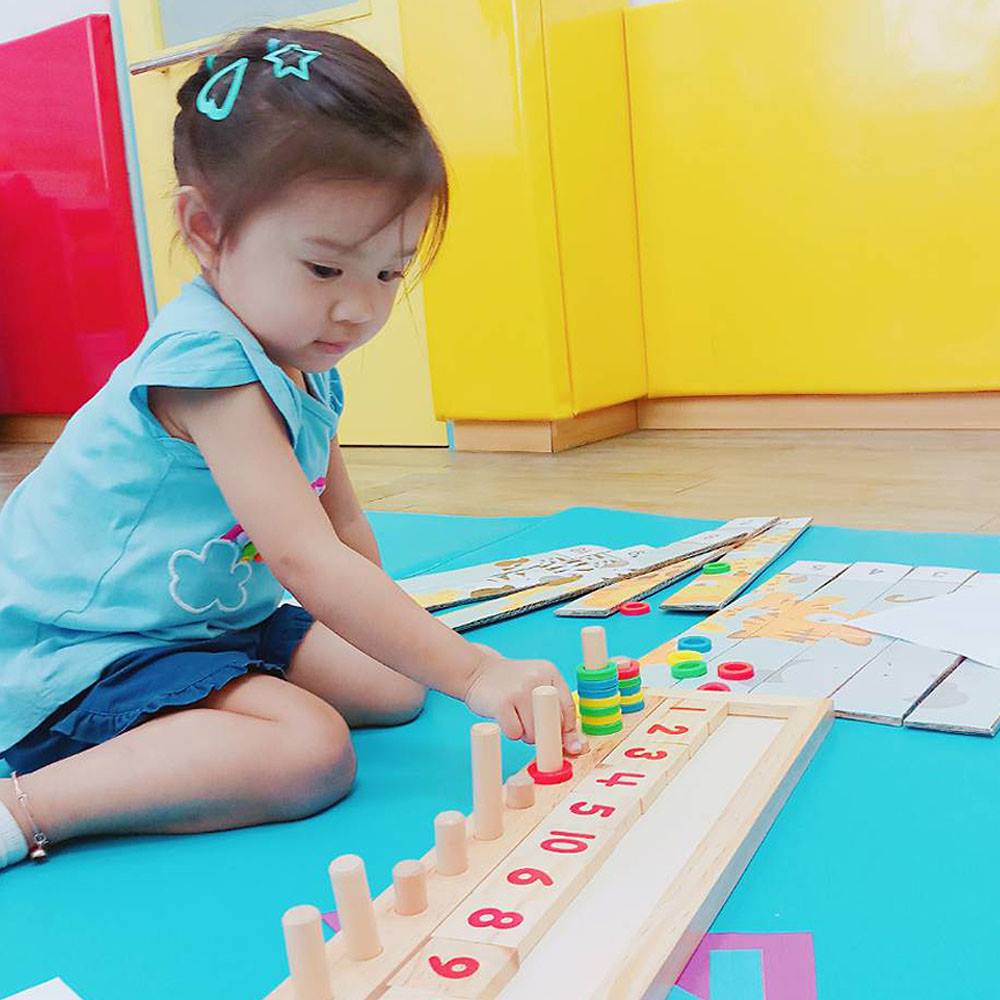
The Montessori approach follows a simple path: children first handle real objects, then pictures, and only later abstract symbols. A child who has counted ten wooden beads, built a number rod staircase and placed pegs on a counting board understands what “10” means. Written sums then make sense instead of being a code to memorise.
What children explore
- Numbers: counting, comparing, place value, then the four operations.
- Geometry: shapes, symmetry and space, often through puzzles and building.
- Measuring: length, weight, time and money in real situations.
- Handling data: sorting, tables and simple charts.
- Problem-solving: choosing a strategy, explaining it and checking the answer.
Maths at KidAble
Our Mathematics program is inspired by the Montessori method and aligned with both Thai and international curricula. It covers these five content areas across six progressive levels, each of at least 80 hours, for children from 3 to 12 years old. Mental calculation, games and interactive activities keep children engaged, and a level test before registration makes sure each child starts in the right group.
A bonus for bilingual families: maths can also be a context for practising English or Chinese, since numbers, shapes and measurements are everyday vocabulary.
Five maths games for home
- Shop at home: price a few toys, give your child coins and play shopkeeper.
- Kitchen maths: measure, weigh and count ingredients together.
- Shape hunt: find circles, triangles and rectangles around the house or in the street.
- Dice games: add two dice, or race to 100 on a board.
- “How did you know?”: ask your child to explain their thinking. Explaining is half of understanding.
Signs your child might need support
Counting on fingers for a long time, avoiding homework or saying “I’m bad at maths” are signals worth listening to. A small group or personal tutoring can rebuild confidence quickly.
Discover our Mathematics program or book a free trial class.