English spelling can look confusing: why does “cat” sound so different from “car”? Phonics is the method most English-speaking schools use to teach children to read, and it works just as well for Thai children learning English as a second language.
What is phonics?
Phonics teaches children the link between sounds and letters. Instead of memorising whole words, children learn that the letter “s” makes a /s/ sound, “a” makes /a/, “t” makes /t/. Then they learn to blend those sounds together: s-a-t, sat. Once a child knows around 40 sound–letter patterns, they can read thousands of new words on their own.
The main steps
- Listening to sounds: rhymes, songs and “I spy something beginning with…” games train the ear.
- Single letter sounds: learning the sound of each letter (not only its name: “b” says /b/, not “bee”).
- Blending: putting sounds together to read short words like sun, bed, pig.
- Segmenting: breaking a word into sounds to spell it.
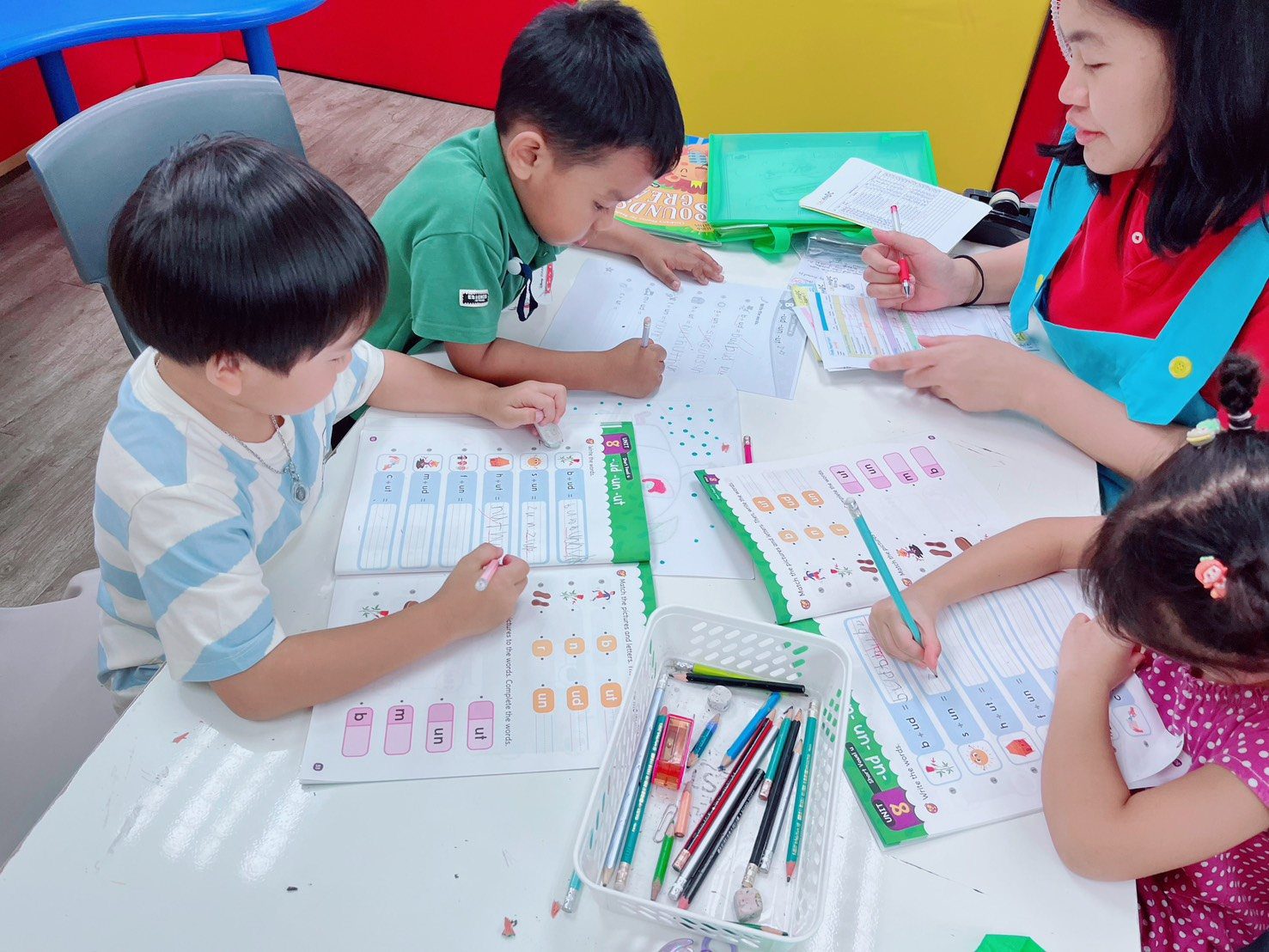
- Word families and digraphs: patterns such as -un, -ug or sh, ch, th.
- Tricky words: high-frequency words that do not follow the rules, like the, said, was.
Why phonics works for Thai children
Many English sounds do not exist in Thai, and final consonants are often softened. Phonics trains children to hear and produce these sounds clearly from the start. It also gives them a strategy: when they meet a new word, they can sound it out instead of guessing.
Phonics at KidAble
Phonics is at the heart of our Kid Group program for children around 3 to 6 years old, alongside counting, writing and handicraft. Children learn with songs, actions, workbooks and games in small groups of 5 to 8, so the teacher can hear every child read. The Junior Group then builds on these foundations towards fluent reading and writing.
Phonics games for home
- Sound hunt: “Find something that starts with /m/!” (mango, mirror, mum).
- Robot talk: say words in separate sounds, “c-a-t”, and let your child blend them.
- Rhyme time: how many words rhyme with “hat”?
- Read together every day: let your child point to the words and sound out the easy ones.
Curious about your child’s reading level? Try our free online English test, discover our English and Chinese programs, or book a free trial class.