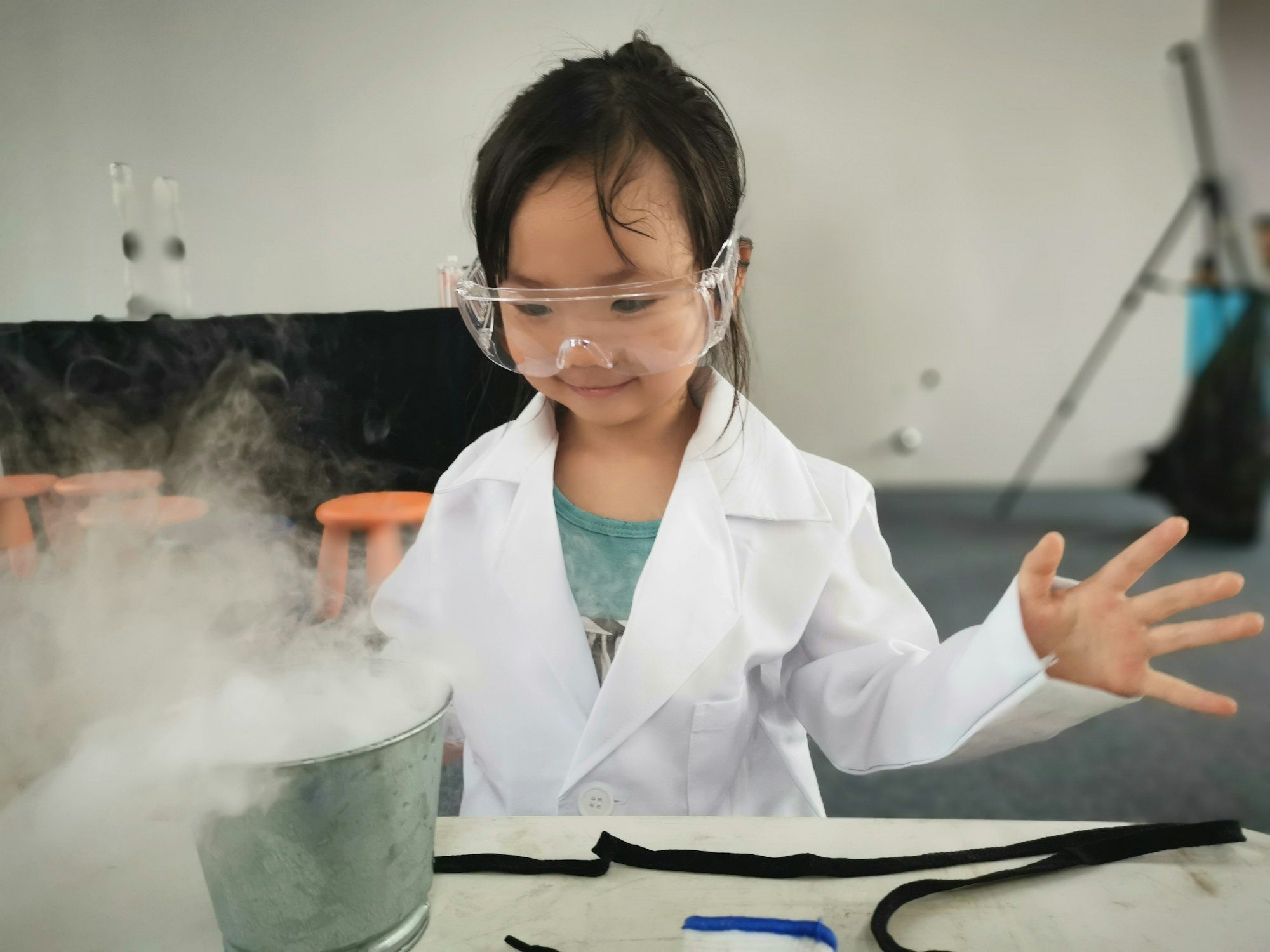
The October school break is a perfect time to turn the kitchen into a small laboratory. These five experiments use everyday materials, take less than 30 minutes and work for a wide range of ages. Younger children enjoy the “wow”, older ones can predict, measure and explain.
Safety first: an adult should always supervise, and nothing used in an experiment should be tasted.
1. The fizzing volcano
You need: baking soda, vinegar, a little dish soap, food colouring, a cup on a tray.
Put two spoons of baking soda in the cup, add a drop of soap and colouring, then pour in vinegar. The mixture fizzes up and over.
The science: an acid (vinegar) and a base (baking soda) react and release carbon dioxide gas.
2. Walking water rainbow
You need: 5 clear cups, water, red, yellow and blue food colouring, paper towels.
Fill cups 1, 3 and 5 with coloured water, leave 2 and 4 empty, and connect them with folded paper towels. Over a few hours, the water “walks” and mixes new colours.
The science: capillary action, the same way plants draw water up from their roots.
3. Sink or float?
You need: a basin of water and objects such as a coin, a leaf, a lime, a plastic spoon, a piece of foil.
Ask your child to predict before each test, then sort the results in two groups. Then shape the foil into a boat: does it float now?
The science: density and buoyancy.
4. Magic milk
You need: a plate of milk, a few drops of food colouring, dish soap, a cotton bud.
Touch the centre of the milk with a soapy cotton bud and watch the colours burst away.
The science: soap breaks the surface tension and reacts with the fat in the milk.
5. Grow a bean in a jar
You need: a glass jar, damp cotton or paper towel, a few dried beans.
Place the beans against the glass, keep the cotton damp and observe every day. Older children can measure and draw the growth in a diary.
The science: germination, roots and the needs of living things.
Turn play into real science
- Ask “What do you think will happen?” before, and “Why do you think it happened?” after.
- Change one thing at a time: more vinegar, warmer water, a different paper.
- Draw or write the results. Bilingual bonus: do it in English or Chinese.
Sciences at KidAble
Our Sciences program turns biology, chemistry, physics and geology into exciting discoveries through hands-on experiments, digital games and practical exercises. Covering kindergarten to primary content for ages 3 to 12, it nurtures curiosity, critical thinking and confidence, and it is taught in English or Chinese. Discover our Sciences program or book a free trial class.